How Do Genetics and Orthodontic Issues Shape Kids’ Dental and Facial Development
October 1, 2026
Dr. Bilkisu Idakoji
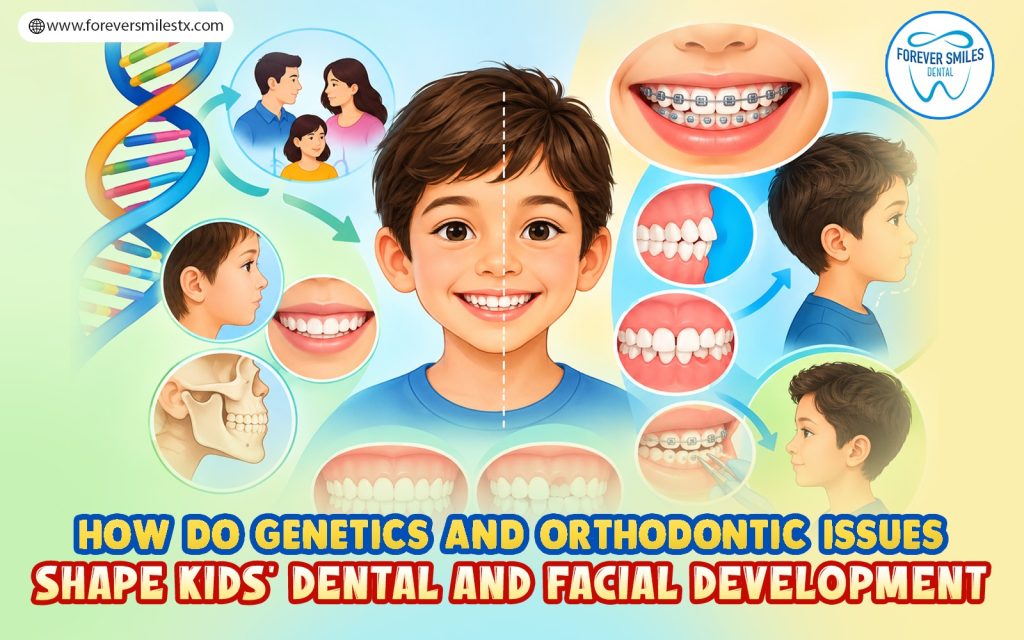
A child’s smile is more than a collection of teeth. The size of the jaw, shape of the face, position of the teeth, bite, and even the way a child chews can be influenced by a combination of genetics, growth, habits, and oral health. This is why Kids Dentistry at Houston is not only about treating cavities but also about watching how a child’s mouth and face develop over time. If parents notice crowded teeth, an unusual bite, or a family history of orthodontic problems, they may wonder whether their child will experience the same concerns. Genetics can play an important role, but it is only one piece of the puzzle. Early dental observation, healthy habits, and timely professional guidance can all influence how a child’s smile develops.
Genetics Can Influence More Than Eye Color and Height
Children inherit many physical characteristics from their parents. Jaw size, tooth size, facial structure, and certain patterns of tooth development can also have a genetic connection.
For example, one parent may have naturally large teeth while the other has a smaller jaw. A child could inherit a combination of these traits, leaving less room for permanent teeth to fit properly. This may eventually contribute to crowding.
Genetics can influence several aspects of dental and facial development, including:
- The size and shape of the upper and lower jaws
- The size and shape of individual teeth
- The amount of space available for permanent teeth
- The relationship between the upper and lower jaws
- The direction of facial growth
- The timing and path of tooth eruption
- The tendency toward certain bite problems
- Overall facial proportions and symmetry
This does not mean that children will automatically develop the same dental problems as their parents. Instead, family history can indicate a greater possibility of certain conditions.
A parent who needed orthodontic treatment should not assume that their child will definitely need the same treatment. However, knowing the family history gives dental professionals useful information when monitoring a child’s development.
Why Some Children Have Crowded Teeth
Crowding is one of the most noticeable orthodontic concerns in growing children. It happens when there is not enough space in the jaw for the teeth to line up properly.
There are several possible reasons for this. A child may have relatively large permanent teeth, a smaller dental arch, or a combination of both. Genetics can influence these characteristics.
Sometimes crowding becomes obvious when permanent teeth begin replacing baby teeth. Parents may notice that a new tooth appears behind another tooth, teeth overlap, or there seems to be very little space between developing teeth.
Crowding is not always something that requires immediate treatment. In some children, the jaws continue growing and create additional space naturally. In others, however, the lack of space may become more pronounced.
This is why simply looking at the front teeth is not enough. A dental professional needs to consider the child’s overall growth, tooth eruption pattern, jaw relationship, and available space.
Overbites and Underbites Can Have a Family Connection
The way the upper and lower jaws relate to one another has a major effect on a child’s bite and facial appearance.
An overbite occurs when the upper front teeth extend too far over the lower front teeth. A mild overbite can be normal, but a deeper bite may sometimes be associated with the position or growth of the jaws.
An underbite is the opposite pattern, where the lower teeth or jaw extend in front of the upper teeth. In some cases, an underbite is mainly related to tooth position. In others, the underlying jaw relationship has a stronger skeletal component.
Certain jaw-growth patterns can run in families. If several family members have had significant underbites or other skeletal bite differences, it is useful for parents to mention this during dental visits.
This does not mean a child will necessarily develop the same condition. It simply gives the dental team another reason to pay attention to growth and development.
Genetics Does Not Work Alone
It can be tempting to blame genetics whenever a child develops an orthodontic concern. However, dental development is much more complicated than that.
Genetic factors create a foundation, while environmental influences and everyday habits can affect how that foundation develops.
Some habits and conditions that may influence dental development include:
- Prolonged thumb sucking
- Extended pacifier use
- Mouth breathing
- Tongue-position problems
- Certain swallowing patterns
- Poor oral hygiene
- Premature loss of baby teeth
- Dental trauma
- Teeth grinding
For instance, prolonged thumb sucking can place pressure on developing teeth and influence their position. Mouth breathing may also be associated with changes in oral posture and should be discussed with a dental professional, particularly when it is persistent.
The result is a fascinating combination of nature and nurture. Two siblings can share many genes but still develop noticeably different dental patterns.
Baby Teeth Have an Important Job
Some parents assume baby teeth do not matter because they will eventually fall out. In reality, primary teeth play an important role in guiding the developing permanent teeth.
Baby teeth help children chew food, develop clear speech, and maintain space for permanent teeth. When a baby tooth is lost much earlier than expected because of decay or injury, nearby teeth may move into the empty space.
This can reduce the room available for the permanent tooth that is still developing underneath.
For this reason, maintaining healthy baby teeth is an important part of orthodontic prevention. Regular dental care can help identify decay, premature tooth loss, eruption concerns, and other issues before they interfere with normal development.
How Bite Problems May Affect Facial Development
Orthodontic concerns are not simply about whether teeth look straight. The teeth, jaw joints, muscles, and facial bones work together every day.
A child’s bite determines how the upper and lower teeth meet during chewing. If the bite is significantly uneven, a child may develop a habit of shifting the jaw to find a more comfortable position.
Over time, a persistent functional shift may influence how the jaw is used during growth.
This does not mean every crooked tooth will change a child’s facial structure. Many dental irregularities have little effect on overall facial development. The concern is greater when an orthodontic problem involves the relationship between the jaws or creates a significant functional imbalance.
Early observation helps professionals distinguish between conditions that can simply be monitored and those that may benefit from intervention.
When Should Parents Become More Observant?
Parents do not need to become orthodontic experts. However, knowing a few warning signs can make it easier to recognize when professional advice may be useful.
Parents can watch for:
- Teeth that overlap significantly
- Permanent teeth erupting in unusual positions
- A noticeable gap between the upper and lower teeth
- Difficulty biting food
- Difficulty chewing comfortably
- A jaw that shifts when the child closes their mouth
- Frequent mouth breathing
- Persistent open-mouth posture
- Early or delayed loss of baby teeth
- Permanent teeth that do not appear when expected
- Speech concerns associated with oral function
- Frequent jaw discomfort or unusual clicking
These signs do not necessarily mean a child needs orthodontic treatment. They simply indicate that a closer look may be worthwhile.
Why Regular Dental Visits Matter
A child’s dental visit is an opportunity to observe development, not just look for cavities.
During routine care, dental professionals can monitor how baby teeth are developing, whether permanent teeth are erupting as expected, and whether there are early signs of crowding or bite problems.
A Pediatric dental exam can also provide parents with useful information about oral hygiene, tooth eruption, habits, and the overall condition of the child’s mouth.
Regular visits make it easier to compare changes over time. A concern that appears minor at one age may become more obvious as permanent teeth erupt. On the other hand, something that looks unusual may correct itself naturally as the child grows.
The key is ongoing observation rather than waiting for a serious problem to develop.
What Happens During an Early Orthodontic Evaluation?
Many orthodontic organizations recommend that children have an initial orthodontic evaluation during the early mixed-dentition years, often around age seven. This does not mean every child will begin orthodontic treatment at that age.
An early assessment may involve examining:
- The child’s bite
- Jaw relationships
- Tooth eruption
- Dental arch width
- Available space
- Facial growth
- Tooth crowding
- Oral habits
The professional may simply recommend monitoring the child’s growth.
In other cases, early guidance may be considered if there is a significant developing issue. The benefit of an early assessment is that parents gain information about what is happening now and what may happen as the child grows.
Where Hospital Dentistry May Be Helpful
Most children’s dental needs can be managed in a regular dental setting. However, some children may require a more specialized environment because of extensive treatment needs, medical considerations, anxiety, developmental differences, or the need for treatment under specialized conditions.
In such situations, Hospital dentistry can provide access to additional facilities and coordinated care when appropriate.
The decision to use a hospital-based setting depends on the child’s individual circumstances. It should not be viewed as a routine requirement for orthodontic or dental care.
The important principle is choosing an environment where the child’s dental and overall needs can be managed safely and appropriately.
Can Parents Prevent Genetic Orthodontic Problems?
Parents cannot change their child’s genes, but they can support healthy dental development.
Good oral hygiene is one of the most important steps. Children should receive age-appropriate brushing guidance and regular professional dental care. Parents should also encourage healthy eating habits and limit frequent exposure to sugary foods and drinks.
Protecting baby teeth is equally important. If a child experiences a dental injury or loses a baby tooth earlier than expected, parents should seek professional advice.
Parents can also observe habits such as thumb sucking, prolonged pacifier use, mouth breathing, and teeth grinding. Addressing these concerns early may reduce their impact on developing teeth and jaws.
In other words, genetics may influence the starting point, but daily care can still make a meaningful difference.
Why Every Child’s Development Is Different
One of the biggest mistakes parents can make is comparing their child’s teeth with those of siblings, friends, or relatives.
Children grow at different rates. One child may lose baby teeth early, while another keeps them longer. One may have spacing between baby teeth, while another may appear crowded.
Even children who share the same parents can have very different combinations of inherited traits.
This is why dental development should be evaluated according to the individual child rather than a family comparison.
A Pediatric dental exam gives dental professionals an opportunity to assess the child’s specific growth and development rather than relying on assumptions based on appearance or family history.
Early Guidance Does Not Always Mean Braces
When parents hear the word orthodontics, they often immediately think about braces. However, early orthodontic care is not always about starting treatment.
Sometimes the best approach is simply observation.
A child may need regular monitoring to see how permanent teeth erupt. Another child may benefit from maintaining space after premature tooth loss. In some situations, early correction of a developing bite problem may be recommended.
The appropriate approach depends on the child’s age, growth pattern, dental development, and specific orthodontic concern.
The purpose of early assessment is to understand what is happening and determine whether action is needed—not to rush children into treatment.
Building a Healthy Smile Starts Early
A child’s dental and facial development is a long process. It begins before all permanent teeth have erupted and continues throughout the growing years.
Genetics can influence jaw size, tooth size, bite relationships, and facial structure. At the same time, habits, oral health, breathing patterns, baby-tooth health, and growth can influence how those inherited traits express themselves.
Parents do not need to predict the future of their child’s smile. Instead, they can focus on what they can control: regular dental visits, healthy oral habits, balanced nutrition, attention to unusual changes, and timely professional advice.
A Pediatric dental exam can be an important part of this process because it allows developing concerns to be identified and monitored rather than discovered only after they become complicated.
Conclusion
Genetics can have a powerful influence on a child’s teeth, jaws, bite, and facial growth, but it does not determine the final outcome on its own. Family patterns such as crowding, unusual jaw relationships, and certain bite concerns can provide useful clues, while habits and environmental factors can also shape development. Regular Kids Dentistry at Houston visits allow dental professionals to monitor these changes and provide guidance when needed. For children requiring specialized care, Hospital dentistry may offer an appropriate treatment setting based on individual needs. Most importantly, a timely Pediatric dental exam can help parents understand how their child’s smile is developing and whether observation or early intervention may be beneficial. With awareness, consistent care, and professional guidance, families can give children a strong foundation for a healthy, comfortable, and confident smile.