How CBCT Helps Orthodontists See the Full Picture Not Just Your Teeth
May 1, 2026
Dr. Bilkisu Idakoji
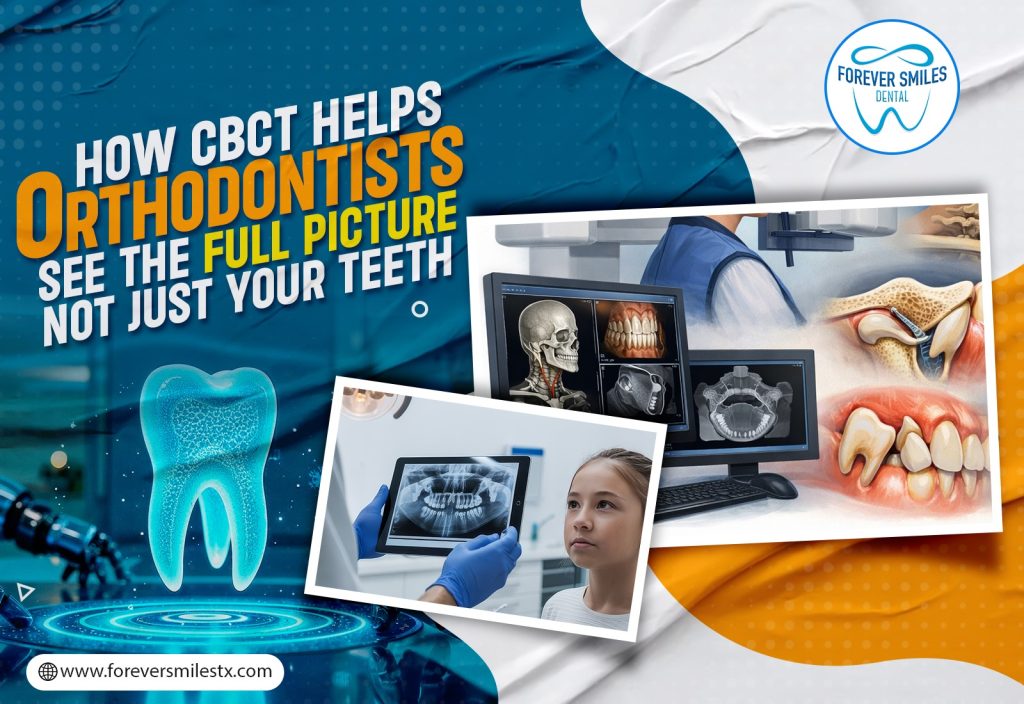
When parents think about orthodontic care, they often picture braces, aligners, and straight teeth. These are the visible results, the part everyone sees at the end of treatment. But what truly determines the success of that treatment happens long before any brackets or aligners are placed. It starts with one critical step: accurate diagnosis. Because orthodontics isn’t just about what we can see on the surface, it’s about understanding what’s happening beneath the gums, within the bone, and around the airway.
Every child’s smile is supported by a complex system of structures working together. Teeth are guided by roots, supported by bone, influenced by jaw growth, and even affected by breathing patterns. When any part of this system is not developing as expected, it can impact alignment, function, and long-term stability. The challenge is that many of these issues are not visible during a routine exam or even in a simple photograph of the smile.
Traditionally, orthodontists relied on 2D X-rays and visual exams to assess a child’s teeth and bite. While these tools have been valuable for many years, they come with limitations. They flatten three-dimensional structures into a single image, making it difficult to fully understand depth, positioning, and the relationship between teeth, roots, and surrounding bone. Important details like the exact position of a tooth root or the thickness of supporting bone, can be partially hidden or difficult to interpret.
This is where CBCT (Cone Beam Computed Tomography) changes everything.
CBCT gives orthodontists a detailed 3D view of your child’s teeth, jaws, roots, airway, and surrounding structures, all in one scan. Instead of relying on estimation, they can evaluate every angle with precision. They can see how teeth are positioned within the bone, how close roots are to each other, whether there is enough space for proper movement, and even how airway structure may be influencing development.
This level of insight transforms how treatment is planned. It allows orthodontists to make more informed decisions, avoid potential complications, and tailor care to each child’s unique anatomy. For parents, this means more clarity, fewer unexpected issues during treatment, and greater confidence that every step is based on a complete and accurate understanding, not just what’s visible on the surface.
What Is CBCT and How Does It Work?
CBCT, or Cone Beam Computed Tomography, is an advanced imaging technology that creates a three-dimensional view of the teeth, jaws, and surrounding structures.
What CBCT actually does
Unlike traditional X-rays, CBCT:
- Captures multiple images from different angles
- Combines them into a single 3D model
- Allows orthodontists to view structures from any direction
This means nothing is “hidden” behind other structures, which is often the case in 2D imaging.
How the scan works
The process is simple and quick:
- The patient stands or sits still
- The scanner rotates around the head
- Images are captured in seconds
- A detailed 3D model is created
There’s no discomfort, and the scan is non-invasive.
What CBCT shows beyond teeth
CBCT doesn’t just show the visible part of teeth. It reveals:
- Tooth roots and their exact position
- Jawbone thickness and density
- Impacted or unerupted teeth
- Airway space and breathing pathways
- Jaw joint (TMJ) structure
This level of detail allows orthodontists to see the full picture, not just the surface.
Why it’s becoming essential
As orthodontics becomes more precise and personalized, CBCT is increasingly used to:
- Improve diagnostic accuracy
- Reduce guesswork
- Plan safer and more effective treatments
Why 2D Imaging Isn’t Always Enough
Traditional dental X-rays have been used for decades, and they still play a role in orthodontics. However, they have limitations that can affect how accurately a problem is diagnosed.
The limitation of flat images
2D X-rays compress three-dimensional structures into a flat image. This means:
- Depth is not clearly visible
- Overlapping structures can hide important details
- Angles can distort the true position of teeth
What can be missed
Because of these limitations, certain issues may not be fully visible, such as:
- Exact root positioning
- Bone thickness around teeth
- Impacted teeth hidden behind others
- Subtle jaw discrepancies
Why depth matters
Orthodontic treatment involves moving teeth through bone. Without understanding:
- How thick the bone is
- Where the roots are positioned
- How close teeth are to each other
treatment planning becomes less precise.
The risk of relying only on 2D
When only 2D imaging is used:
- Some conditions may be underestimated
- Treatment plans may need adjustment later
- There may be a higher risk of complications
CBCT helps eliminate these uncertainties by providing a complete, accurate view.
What Orthodontists Can See with CBCT
CBCT gives orthodontists a level of detail that simply isn’t possible with traditional imaging. Instead of viewing a flat, limited picture, they can explore a full 3D model of the teeth, jaws, and surrounding structures. This allows them to evaluate not just where the teeth are, but how everything works together as a system, something that is essential for accurate diagnosis and safe treatment planning.
Tooth position and root structure
One of the most important advantages of CBCT is the ability to see the exact position of each tooth, not just the visible crown, but the entire structure beneath the gums. Orthodontists can evaluate how teeth are angled, how deep they are positioned within the bone, and how their roots are oriented. They can also see whether roots are close to each other or overlapping, which is critical when planning tooth movement. This level of detail helps ensure that teeth are moved safely and efficiently without damaging surrounding structures.
Jawbone quality and thickness
CBCT also provides a clear view of the bone that supports the teeth. Orthodontists can assess how much bone surrounds each tooth and whether there is enough support for movement. In some cases, areas of the jaw may be thinner than expected, which can limit how far a tooth can safely move. Identifying these details early helps prevent complications and allows treatment to be planned within safe biological limits, protecting long-term dental health.
Impacted or hidden teeth
Some teeth do not erupt properly and remain trapped beneath the gums or bone. This is especially common with canines. With traditional imaging, it can be difficult to determine their exact position, but CBCT makes it possible to locate them precisely. Orthodontists can see where the impacted tooth is, the direction it is facing, and how close it is to neighboring teeth. This information is essential for deciding how to guide the tooth into place or whether additional intervention is needed.
Airway and breathing patterns
One of the most valuable and often overlooked, benefits of CBCT is its ability to evaluate the airway. Orthodontists can measure airway size, identify areas where airflow may be restricted, and assess how jaw structure may be affecting breathing. This is particularly important for children who show signs of mouth breathing, snoring, or restless sleep. Understanding airway health allows orthodontic treatment to support not just alignment, but overall well-being.
Jaw joints (TMJ)
CBCT also provides detailed insight into the temporomandibular joints (TMJ), which control jaw movement. Orthodontists can examine the structure and alignment of these joints, as well as how the lower jaw sits within them. This helps identify any irregularities or imbalances that could affect jaw function, comfort, or long-term stability. By understanding how the joints are functioning, treatment can be planned to support smooth, natural movement rather than creating additional strain.
By combining all of this information into one comprehensive view, CBCT allows orthodontists to make decisions based on complete accuracy, not assumptions. This leads to safer, more predictable, and more personalized care for every patient.
How CBCT Improves Diagnosis and Treatment Planning
The biggest advantage of CBCT is how it transforms decision-making in orthodontics. Instead of relying on limited views or estimates, orthodontists can base every step of treatment on precise, three-dimensional information. This shift from assumption to accuracy has a direct impact on both the quality and predictability of care.
Early detection of hidden issues
CBCT allows orthodontists to identify problems long before they become visible in the mouth. Because it captures structures beneath the surface, it can reveal impacted teeth that haven’t erupted, areas where bone support may be limited, or subtle jaw discrepancies that are not obvious during a routine exam. Detecting these issues early makes it possible to plan ahead, rather than reacting later when the problem becomes more complex.
More precise treatment planning
With a complete 3D view, treatment can be tailored to the patient’s exact anatomy rather than a general assumption. Orthodontists can see how each tooth is positioned within the bone, how much space is available, and how the jaws relate to each other. This leads to more accurate alignment strategies, better control over tooth movement, and outcomes that are more predictable. In some cases, it can even help reduce overall treatment time because fewer adjustments are needed along the way.
Safer tooth movement
Orthodontic treatment involves moving teeth through bone, which requires careful planning. CBCT shows exactly where the roots are located and how much bone surrounds them. This allows orthodontists to move teeth within safe boundaries, avoiding areas where bone may be thin or roots may be too close together. By working within these limits, the risk of complications is reduced and long-term tooth health is better protected.
Reduced guesswork
Traditional imaging often requires orthodontists to interpret and estimate positions based on flat images. CBCT removes much of this uncertainty by providing clear, measurable data and accurate visualization from multiple angles. This level of precision gives orthodontists greater confidence in their decisions and reduces the need for mid-treatment corrections.
Better communication with parents
One of the most valuable benefits for families is improved communication. CBCT images make it easier for orthodontists to show parents exactly what is happening inside their child’s mouth. Instead of trying to explain complex issues with words alone, they can visually demonstrate tooth positions, jaw relationships, and potential concerns. This transparency helps parents better understand the treatment plan, builds trust, and allows them to feel more confident in the decisions being made.
By improving diagnosis, enhancing planning, and supporting clearer communication, CBCT elevates the entire orthodontic process, from the first consultation to the final results.
5. How Welcome Orthodontics Uses CBCT for Better Patient Care
At Welcome Orthodontics, technology is not used for the sake of it, it’s used to improve outcomes, clarity, and patient experience. CBCT plays a key role in how the team approaches diagnosis and treatment planning.
From the very first evaluation, the goal is to understand the complete picture of each patient’s dental and facial development. Using advanced CBCT imaging, the team can assess not just teeth alignment, but also jaw structure, root positioning, and airway considerations. This level of detail allows for more accurate and personalized treatment planning. Instead of relying on assumptions, decisions are based on precise data. This is especially important in complex cases where small details can significantly impact results.
What sets Welcome Orthodontics apart is how this technology is combined with a conservative, patient-first approach. Not every child needs immediate treatment, and CBCT helps determine exactly when and how to intervene. This avoids unnecessary procedures while ensuring that important issues are not overlooked. With over 30 years of experience, Dr. Tavakoli uses CBCT as a tool, not a replacement for clinical judgment. The technology supports better decisions, but those decisions are guided by experience and a deep understanding of growth and development.
Parents also benefit from clearer communication. Seeing a 3D image of their child’s teeth and jaw makes it easier to understand what’s happening and why certain recommendations are made. This removes uncertainty and helps families feel more confident in their decisions. Affordability and accessibility are also priorities. For families searching for Affordable orthodontics near me, Welcome Orthodontics provides flexible payment options and works with insurance to make advanced care more accessible.
Most importantly, every treatment plan is tailored. CBCT ensures that no two cases are treated the same, because no two patients are the same.
Conclusion
Orthodontic care is about more than straightening teeth, it’s about understanding how the entire system works together. Teeth, jaws, roots, and airway all play a role in long-term health and function. CBCT has transformed how orthodontists see and plan treatment. By providing a complete 3D view, it allows for more accurate diagnosis, safer treatment, and better outcomes. It removes guesswork and replaces it with clarity.
For parents, this means peace of mind. You can feel confident that your child’s care is based on a full understanding of their development, not just what’s visible on the surface. With advanced technology and expert care from practices like Welcome Orthodontics, families can trust that every decision is made with precision, thoughtfulness, and a focus on long-term health.
Because when orthodontists can see the full picture, they can create better smiles and healthier futures.