Midline Misalignment in Children: Why the Center of Your Child’s Smile Looks Off
August 17, 2026
Dr. Bilkisu Idakoji
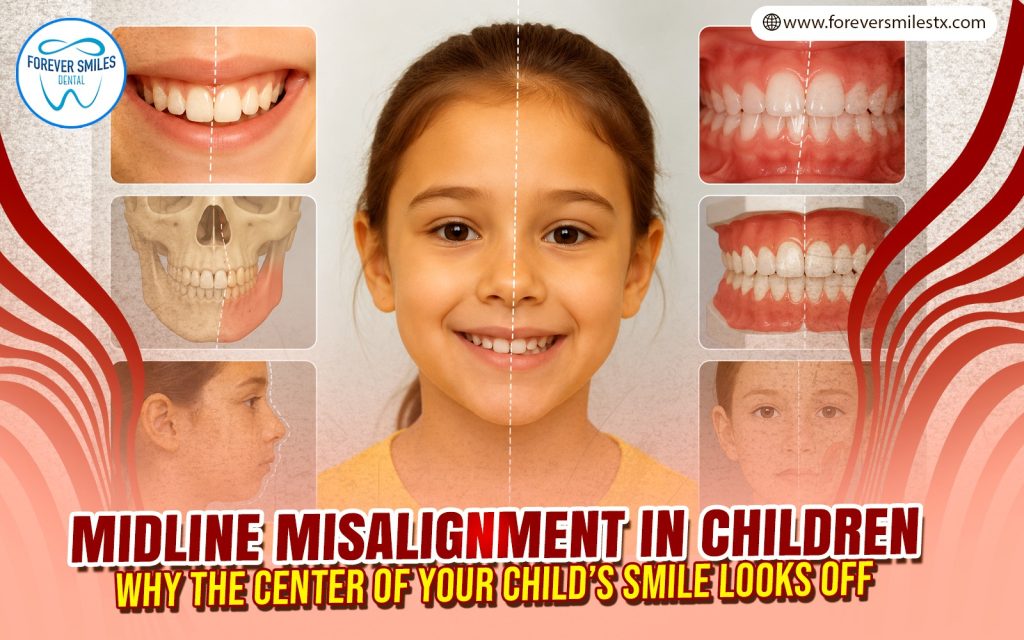
Have you ever looked closely at your child’s smile and noticed that the center of their upper teeth doesn’t quite match the center of their lower teeth or even the middle of their face? That small shift is known as midline misalignment.
Sometimes, it is simply a minor difference that has little effect on oral health. In other cases, an off-center dental midline can be a clue to something happening beneath the surface, such as uneven tooth eruption, crowding, early loss of a baby tooth, a crossbite, or differences in jaw development.
Because children’s mouths change considerably as baby teeth fall out and permanent teeth emerge, knowing what to watch for can help parents distinguish normal developmental changes from something worth discussing with a dentist.
What Is Midline Misalignment?
The dental midline is the imaginary vertical line that runs between the two front teeth. There is an upper dental midline between the two upper central incisors and a lower dental midline between the two lower central incisors. Ideally, these lines are reasonably aligned with each other and with the center of the face. Midline misalignment, also called a dental midline shift or midline discrepancy, occurs when these reference points do not line up as expected.
For example, your child’s upper front teeth may appear centered with their face, while the lower front teeth are shifted slightly to one side. In another child, both dental midlines may appear displaced relative to the facial center. The amount of shift and, more importantly, why it is happening determine whether treatment may be needed.
What Does a Normal Dental Midline Look Like?
When you look directly at a balanced smile, the line between the two upper front teeth generally sits close to the center of the face. The lower dental midline usually aligns reasonably closely with the upper one. However, perfect symmetry is not required for a healthy smile.
Small differences can occur naturally, and a slight midline discrepancy may not cause any functional problems at all. This is especially important to remember in children. Their smiles are constantly changing as baby teeth loosen, gaps temporarily appear, permanent teeth erupt, and the jaws continue growing.
Instead of judging a midline by appearance alone, dentists consider the entire bite and stage of development.
How Can You Tell If Your Child’s Dental Midline Is Off?
A midline shift can sometimes be spotted at home, particularly when your child smiles or bites their teeth together. Here are some signs parents may notice.
Upper and Lower Front Teeth Don’t Line Up
Ask your child to gently bite their back teeth together and smile naturally. Look at the line between the two upper front teeth and compare it with the line between the two lower front teeth. If one line sits noticeably to the left or right of the other, there may be a dental midline discrepancy. This simple observation cannot tell you what is causing the shift, but it can give you a reason to mention it during your child’s next dental visit.
Center of the Teeth Doesn’t Match the Center of the Face
Sometimes the upper and lower dental midlines may align with each other but appear shifted relative to the center of the face. Dentists assess facial landmarks along with the teeth to understand whether the difference is primarily dental, skeletal, or related to natural facial asymmetry. Photos taken straight from the front may make an off-center smile easier to notice.
Uneven Spacing or Crowding
Look for differences between the two sides of your child’s smile. There may be extra spacing on one side, while the other side appears crowded. A tooth may also erupt into an unusual position because there isn’t enough room. Uneven space distribution can gradually influence the position of the front teeth and contribute to a midline shift.
One Side of the Bite Looks Different
A midline discrepancy may occur alongside another bite problem. For example, the teeth on one side may fit together differently from those on the opposite side. There may be crowding, a crossbite, or differences in how certain teeth have erupted. An uneven bite is particularly worth evaluating if your child also shifts their jaw when closing their mouth.
Jaw Shifts When Your Child Bites Down
Watch your child’s jaw as they slowly close their mouth. Does it seem to move slightly toward one side just before the teeth come together? This may be a functional shift, meaning the jaw changes position to find a more comfortable way for the teeth to fit together.
A functional shift can make the lower dental midline appear displaced and may be associated with bite problems such as a crossbite.
What Causes Midline Misalignment in Children?
There are several possible causes, and sometimes more than one factor is involved.
Early or Delayed Loss of Baby Teeth
Baby teeth help preserve space and guide permanent teeth into position. If a baby tooth is lost earlier than expected, nearby teeth may begin moving into the available space. If this happens unevenly on one side, the dental midline can gradually shift. A baby tooth that remains longer than expected may also affect how permanent teeth emerge.
Missing or Extra Teeth
A child who is naturally missing a permanent tooth may develop uneven spacing that influences the midline. An extra tooth can create the opposite problem by blocking normal eruption or pushing nearby teeth away from their expected positions. Dental X-rays may sometimes be needed to identify these issues.
Crowding and Uneven Tooth Eruption
Permanent teeth do not always erupt symmetrically. If one tooth emerges earlier than its counterpart or there is insufficient space, the front teeth may shift toward the side with more available room. Crowding is therefore an important factor dentists consider when evaluating an off-center dental midline.
Differences in Tooth Size or Spacing
Teeth are not always perfectly symmetrical in size and shape. Differences in tooth width or uneven spaces can influence how the front teeth are positioned. Although these differences may seem minor, they can contribute to visible midline discrepancies.
Jaw Growth and Skeletal Asymmetry
Sometimes the issue extends beyond tooth position. Differences in how the upper or lower jaw develops can affect facial symmetry and the relationship between the dental midlines. Skeletal causes require careful assessment because treatment planning may differ from a simple tooth-position problem.
Crossbite and Functional Jaw Shifts
A crossbite can sometimes cause a child to move their lower jaw sideways when closing their mouth so the teeth fit together more comfortably. This functional shift can make the lower midline appear off-center. Identifying this type of problem early can be important because the issue involves how the bite functions, not just how the smile looks.
Dental Trauma and Premature Tooth Loss
An injury that damages or causes the early loss of a baby tooth may affect spacing and the eruption path of permanent teeth. This is one reason dental trauma in childhood should be evaluated even if the immediate injury seems minor.
How Is Midline Misalignment Diagnosed?
Correcting a midline successfully begins with understanding why it is misaligned. During an evaluation, the dentist or orthodontist may look at several factors rather than focusing only on the front teeth.
Examining the Facial and Dental Midlines
The dental professional compares the upper and lower dental midlines with each other and with facial landmarks. This helps determine whether one dental arch is shifted, both are displaced, or facial or jaw asymmetry may be contributing to the appearance.
Checking How the Upper and Lower Teeth Fit Together
Your child will be asked to bite naturally so the relationship between the upper and lower teeth can be examined. The dentist may look for crowding, spacing, crossbites, missing teeth, unusual tooth positions, or other forms of malocclusion that could explain the midline discrepancy.
Evaluating Jaw Movement and Facial Symmetry
How the jaw moves can provide an important clue. If the lower jaw shifts to one side as the teeth come together, the apparent midline discrepancy may be partly functional rather than caused only by tooth position. Recognizing a functional shift is important because treatment may need to address the bite interference causing the jaw to move.
When X-Rays, Photographs, or Digital Scans May Be Needed
Depending on the child’s age and dental development, additional diagnostic records may be recommended. Dental X-rays can help identify missing or extra teeth, unerupted permanent teeth, root positions, and other factors hidden beneath the gums. Photographs, dental models, or digital scans may also help evaluate tooth positions, spacing, bite relationships, and treatment needs.
How Is Midline Misalignment Treated in Children?
There is no single treatment for every off-center dental midline. Treatment depends on the cause, severity, age of the child, stage of dental development, and presence of other bite problems.
Monitoring Growth and Tooth Eruption
Sometimes, observation is the most appropriate approach. If a mild midline discrepancy appears during the transition from baby teeth to permanent teeth, the dentist may monitor how the smile changes as additional teeth erupt. Regular checkups help determine whether the discrepancy is improving, remaining stable, or becoming more pronounced.
Creating or Preserving Space
If early loss of a baby tooth has affected available space, managing that space may be part of treatment. In some situations, a dentist or orthodontist may recommend an appliance to preserve or manage space for developing permanent teeth. The appropriate approach depends on which tooth was lost, the child’s age, and how much dental development remains.
Braces and Clear Aligners
Orthodontic treatment can often move teeth to improve a dental midline discrepancy. Braces allow controlled movement of individual teeth and may be used when crowding, spacing, or uneven tooth positions contribute to the shift. Clear aligners may also be appropriate for certain older children or teenagers, depending on the complexity of the problem and their ability to wear the aligners consistently.
Orthodontic Elastics and Other Appliances
Orthodontic elastics may sometimes be incorporated into treatment to help correct specific bite and midline relationships. Other orthodontic appliances may be recommended when arch development, space, or bite relationships need to be addressed. The exact treatment plan is individualized because correcting a visible midline without addressing its underlying cause may not produce a stable or functional result.
Treating Crossbites or Functional Jaw Shifts
When a midline discrepancy is related to a crossbite or functional jaw shift, treatment may focus first on removing the interference that causes the jaw to move sideways. Depending on the problem, this may involve orthodontic appliances or other methods designed to improve the relationship between the upper and lower teeth.
Treatment for Jaw-Related Midline Problems
When the discrepancy is primarily skeletal rather than dental, treatment can be more complex. The approach depends on the child’s growth stage and the extent of the jaw asymmetry. Some problems may be managed during growth, while more significant skeletal discrepancies may require longer-term orthodontic planning. This is why determining whether the problem is dental, skeletal, or functional is so important.
Why Choose Forever Smiles Dental?
When you notice something changing in your child’s smile, getting clear answers can make all the difference. At Forever Smiles Dental, we look beyond individual teeth to consider how your child’s smile, bite, and oral health are developing as a whole.
Dr. B provides gentle, compassionate care designed to help children feel comfortable during dental visits. Whether you have noticed an off-center smile, uneven tooth eruption, crowding, or another change in your child’s bite, we can evaluate the concern and help you understand what it may mean.
Our approach focuses on appropriate care rather than unnecessary treatment. Some dental changes simply need monitoring, while others may benefit from timely intervention or an orthodontic evaluation. We help parents understand their options so they can make informed decisions about their child’s care.
Forever Smiles Dental also believes finances should not unnecessarily delay important dental care. We offer an In-House Dental Insurance Plan and accept financing options such as CareCredit and LendingClub to help make care more accessible for families.
Final Thoughts
An off-center dental midline can be easy to dismiss as a small cosmetic imperfection. Sometimes, that is exactly what it is. But in other cases, midline misalignment can be a visible clue to something else happening in your child’s developing smile, from uneven tooth eruption and early tooth loss to crowding, crossbite, or differences in jaw development.
If you notice that the center of your child’s smile appears to be shifting, don’t try to judge the problem based on appearance alone. Schedule a dental evaluation with Forever Smiles Dental. Understanding why the midline is off is the first step toward deciding whether your child simply needs monitoring or could benefit from additional care to support a healthy, functional smile as they grow.