Understanding Dental Space Maintainers: Types and Caring Technique
October 26, 2026
Dr. Bilkisu Idakoji
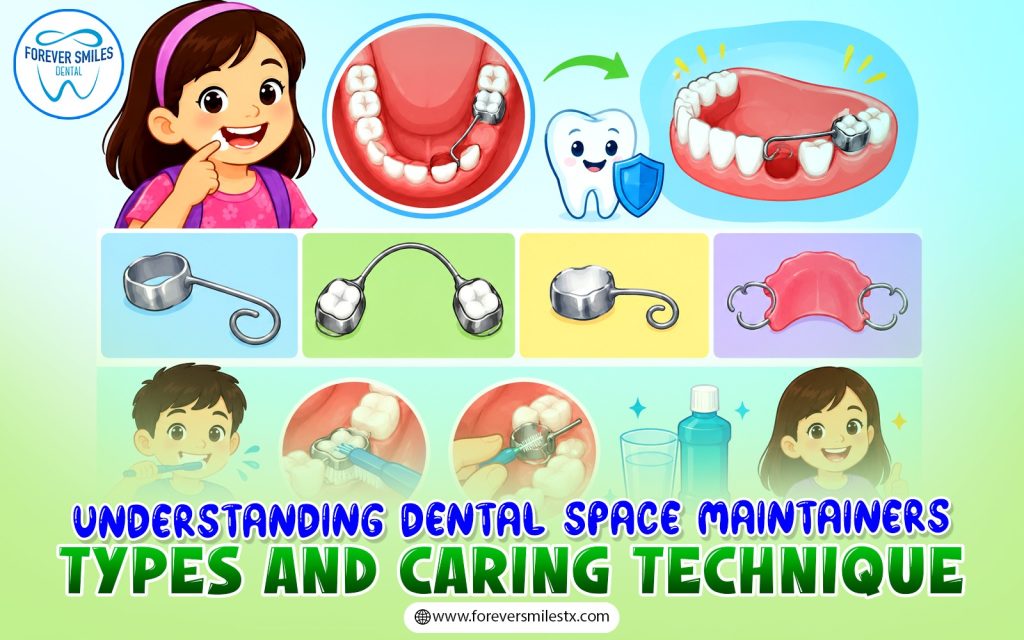
Baby teeth are an important part of your child’s growing smile. They help children chew food, speak clearly, and hold the right amount of space for permanent teeth. Normally, baby teeth loosen and fall out when the adult teeth are ready to come in. But sometimes, a child may lose a baby tooth too early because of tooth decay, infection, an accident, or another dental problem.
When a baby tooth is lost too soon, the teeth around the empty space may begin to move. This can reduce the room available for the permanent tooth that needs to come into that area. In some cases, a dentist may recommend a dental space maintainer to help keep this space open until the permanent tooth is ready to erupt.
For parents looking for Kids Dentistry at Houston, understanding space maintainers can make it easier to know why your child may need one and how to care for it. This article explains what a space maintainer is, the common types, when children may need one, and simple ways to keep the appliance clean and safe.
What Is a Dental Space Maintainer?
A dental space maintainer is a small dental appliance used to help hold the space left by a baby tooth that was lost too early. It may be made from metal, acrylic, or a combination of materials. Depending on your child’s needs, the appliance may be fixed in the mouth or designed to be removable.
Think of it as a placeholder. If a baby tooth is lost before the permanent tooth is ready to come in, nearby teeth can slowly move toward the empty area. A space maintainer helps reduce this unwanted movement and protects the space needed for the developing permanent tooth.
However, not every child who loses a baby tooth needs a space maintainer. A dentist considers several factors, including which tooth was lost, how long ago it was lost, the child’s dental development, the amount of space available, and the position and development of the permanent tooth.
A pediatric dentist may also check your child’s bite and oral hygiene before recommending an appliance. Regular follow-up is important because your child’s mouth continues to grow and permanent teeth continue to develop.
Why Might a Child Need a Space Maintainer?
Baby teeth do more than help children eat and smile. They also help guide the permanent teeth into their future positions. When one is lost too early, the teeth beside the empty space may shift.
For example, imagine that your child loses a baby molar several years before the permanent tooth underneath is ready to erupt. A nearby tooth may move into the empty area. This can make the space smaller. Later, the permanent tooth may not have enough room to come through normally.
Premature tooth loss may contribute to crowding, changes in tooth position, or ectopic eruption. A space maintainer may be considered to reduce the chance of losing useful space.
This does not mean that every child with a space maintainer will avoid orthodontic treatment later. The appliance is mainly intended to maintain the space while the permanent teeth develop. Your child’s dentist will monitor the eruption process and decide when the appliance is no longer needed.
Good oral hygiene is also important during this time. Regular Dental cleaning at Houston can help remove plaque from areas that may be harder to clean around the appliance.
When Can a Child Lose a Baby Tooth Too Early?
There are several reasons why a baby tooth may be lost before its normal time.
Common reasons include:
- Severe tooth decay
- Dental infection
- A tooth injury or accident
- A tooth that cannot be restored
- Certain dental development problems
- Some cases involving abnormal tooth eruption
Baby teeth usually loosen naturally as permanent teeth develop underneath them. Early loss is different because the permanent tooth may still be some time away from entering the mouth.
This is why parents should not assume that an early missing baby tooth is harmless. It is better to have the area checked by a dentist. The dentist can determine whether the space needs to be monitored or maintained.
For families seeking Kids Dentistry at Houston, an early dental examination can help identify changes in tooth position before they become more difficult to manage.
What Are the Different Types of Space Maintainers?
Space maintainers can be grouped into fixed and removable appliances. The right type depends on your child’s age, the tooth that was lost, the location of the space, the condition of nearby teeth, and the developing permanent tooth.
The AAPD describes fixed unilateral, fixed bilateral, and removable space maintainers as common types.
1. Removable Space Maintainers
As the name suggests, a removable space maintainer can be taken out of the mouth. It may look somewhat like a small dental appliance or partial denture.
These appliances can be useful in selected situations. Because they can be removed, children and parents need to follow the dentist’s instructions carefully. The appliance should not be left out for long periods unless the dentist has advised it.
Parents should also make sure the appliance is kept clean and stored safely when it is not being worn.
If your child frequently forgets to wear a removable appliance, tell the dentist. The dental team can check whether another option would be more suitable.
2. Fixed Unilateral Space Maintainers
A fixed unilateral space maintainer is attached to a nearby tooth and is designed to protect space on one side of the mouth. Since it is fixed in place, your child cannot simply remove it at home.
Some common examples include:
Band and Loop
A band and loop space maintainer usually uses a metal band fitted around a nearby tooth. A loop extends into the space created by the missing tooth.
The loop helps keep the neighboring tooth from moving into the empty area. It is one of the commonly used fixed appliances for selected cases of premature tooth loss.
Crown and Loop
A crown and loop works in a similar way, but a dental crown is used on the supporting tooth. The loop extends across the space left by the missing tooth.
The dentist decides whether this option is suitable based on the condition of the supporting tooth and the child’s overall dental needs.
Distal Shoe
A distal shoe is another type of fixed appliance used in certain cases, especially when a primary molar is lost before the permanent first molar has erupted.
Because this appliance extends below the gum, it requires careful placement and regular dental monitoring. It is not appropriate for every child.
3. Fixed Bilateral Space Maintainers
Fixed bilateral space maintainers are designed to manage spaces on both sides of the mouth. They are often considered when several baby teeth have been lost.
Common examples include:
Lingual Holding Arch
A lingual holding arch is generally used in the lower jaw. It connects to teeth on both sides and helps maintain the position of the teeth.
Nance Appliance
A Nance appliance is generally used in the upper jaw. It uses a wire and an acrylic button that rests against the palate.
Transpalatal Arch
A transpalatal arch is also used in the upper jaw. It connects teeth on opposite sides and helps maintain their position.
The exact appliance is selected after the dentist evaluates the child’s mouth and developing teeth. A pediatric dentist may use dental examinations and X-rays when needed to understand the position of the permanent teeth.
How Does a Space Maintainer Help?
The main purpose of a space maintainer is to help preserve the space needed for a permanent tooth.
When a baby tooth is lost early, neighboring teeth may move toward the empty area. The amount of movement can vary depending on the location of the missing tooth, the child’s dental development, and how much time has passed since the tooth was lost.
By maintaining the space, the appliance can help support the normal eruption path of the developing permanent tooth.
It is important to understand that a space maintainer does not straighten teeth. It also does not replace full orthodontic treatment when orthodontic treatment is needed. Its main job is to help preserve the existing space while your child’s permanent teeth develop.
How Should You Care for a Space Maintainer?
Taking care of the appliance is just as important as having it placed. Poor cleaning can allow plaque to collect around the appliance and supporting teeth. The AAPD notes that plaque buildup, cavities, appliance damage, and soft-tissue irritation are possible concerns with space maintainers.
Here are some simple care tips for parents.
Brush Twice a Day
Your child should brush twice a day with fluoride toothpaste. Pay extra attention to the tooth supporting the space maintainer.
Make sure your child gently cleans around the metal band, wires, and other parts of the appliance.
Clean Around the Appliance
Food can become trapped around a space maintainer. Ask your child’s dentist to show you the correct way to clean around the appliance.
Depending on the appliance, the dentist may recommend flossing tools or other cleaning aids.
Avoid Very Sticky Foods
Sticky foods can pull on the appliance or leave food around it. Hard foods may also damage or loosen certain appliances.
Try to limit very sticky or hard foods and follow the specific food instructions given by your child’s dentist.
Do Not Pull or Play With It
Children may be tempted to touch a new appliance with their tongue or fingers. Encourage your child not to push, pull, bend, or play with it.
Trying to move the appliance can loosen it or damage the supporting tooth.
Keep Removable Appliances Safe
If your child has a removable space maintainer, keep it in its protective case whenever it is not being worn.
Do not wrap it in a tissue or leave it loose in a school bag, because it can easily be thrown away or damaged.
Attend Regular Dental Visits
Regular checkups are important when a child has a space maintainer. The dentist needs to check the appliance, the supporting tooth, the gums, and the eruption of the permanent tooth.
Regular Dental cleaning at Houston can also support good oral hygiene while your child is wearing the appliance.
What Should You Do If the Space Maintainer Comes Loose?
A loose or broken space maintainer should not be ignored.
If your child says the appliance feels loose, causes pain, or has broken, contact the dentist. Do not try to glue, bend, or repair it at home.
If a fixed appliance comes out completely, keep it in a clean container and bring it to the dental appointment if possible. The dentist can check whether it can be recemented or needs to be replaced.
Prompt attention is useful because the appliance may no longer be maintaining the space properly.
Can a Space Maintainer Cause Problems?
Space maintainers are useful in selected cases, but they also need proper care and monitoring. Possible problems include plaque buildup, cavities around supporting teeth, a loose or broken appliance, gum irritation, and interference with the developing permanent tooth.
This is why parents should not assume that once the appliance is placed, no further visits are needed.
If your child complains of pain, swelling, bleeding, difficulty eating, or irritation around the appliance, contact the dental office. The dentist can determine what is causing the problem and whether the appliance needs adjustment.
Is a Space Maintainer Needed Until Adulthood?
No. A space maintainer is generally used only while the permanent tooth is developing and moving into the mouth.
The dentist will monitor the permanent tooth and determine when the appliance should be removed. The AAPD notes that the appliance should function until the permanent successor has erupted into the arch, although adjustment or replacement may be needed as the child grows.
The timing is different for every child. It depends on the tooth that was lost and the stage of dental development.
When Might Hospital Dentistry Be Considered?
Most children can receive dental examinations and space-maintainer treatment in a regular dental office. However, some children may need dental treatment in a hospital or specialized setting because of their age, medical needs, developmental needs, or difficulty cooperating with treatment.
Hospital dentistry may be considered when a child needs a level of care or support that cannot be provided safely or comfortably in a standard office setting. The appropriate setting is decided by the dental and medical team after considering the child’s individual needs.
AAPD guidance recognizes that pediatric dental care may require special planning based on a child’s age, development, medical status, and treatment needs.
Parents should always discuss the available treatment setting with their child’s dental provider.
Final Thoughts
At Forever Smiles, Kids Dentistry at Houston can help parents understand their child’s changing smile and receive age-appropriate dental care. Whether your child needs preventive care, monitoring, or a space maintainer, early attention can help support healthy dental development. In selected situations where a child requires additional support, Hospital dentistry may also be discussed as part of the treatment plan. Regular Dental cleaning at Houston and dental checkups can further help keep the teeth and gums healthy while your child grows.